Categories
News Research & Publications

Faulkner’s Modernisms: Available October 2026

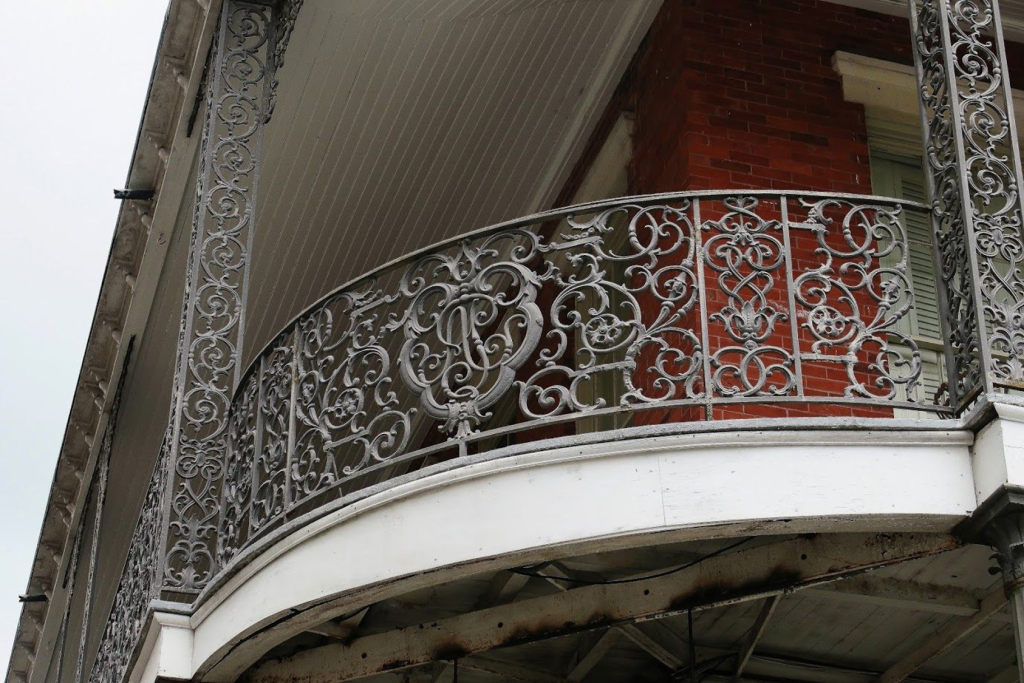
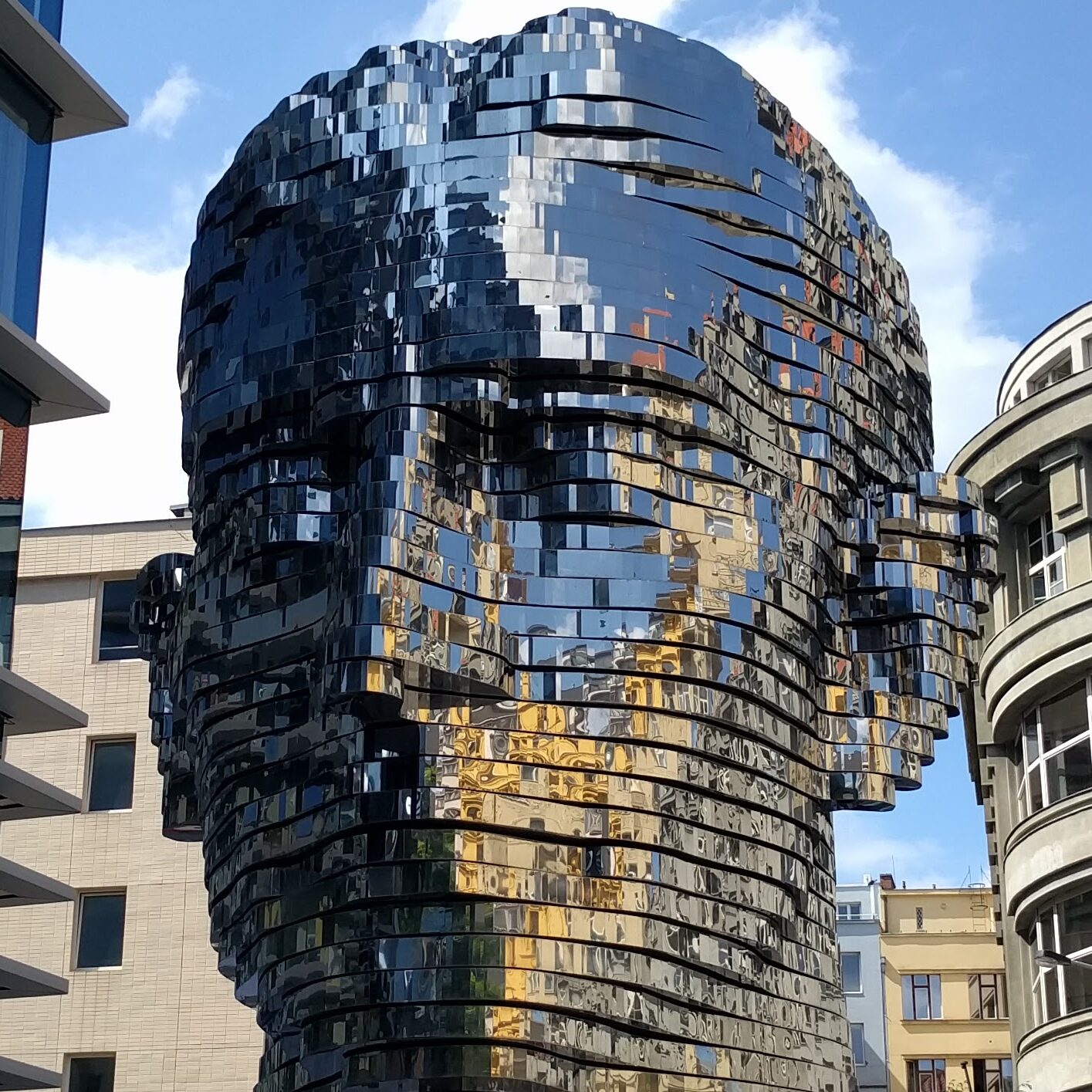
Check out my article in the newest collection of essays on Faulkner published by the University Press of Mississippi. “Faulkner’s Cool Choreographies: Rural Taylorism and the Economy of Bodily Motion” describes how Faulkner’s fiction plays out an unconscious bodily knowledge that results in automatic or mechanized movement; an external temperature incongruous with emotional labor; energy directed toward rigor, deliberation, or accuracy rather than efficiency; an integration with land and materials rather than an attention to the body in isolated time and space; a cool, automatic, and sometimes mechanical detachment between consciousness and the task; and a lack of awareness or nonparticipation in abstract capitalist-driven concepts of time through labor. Faulkner’s account of working time parallels his larger concept of time. His bodies work outside of a homogenous, linear time in which workers imagine themselves simultaneously at work; rather, his working time is directed by the forces of slavery on the land both retroactively and proactively. Rural working bodies are trained not by the environments of industry and “knowledge work,” but rather by the organic and instrumental. In contrast with industrial modernism, a system by which the few shape the many and the producing body is the desired outcome, Faulkner offers a radical representation of the body absorbing and articulating the land back to itself. In this sense, Faulkner produces his own coolness toward a capitalist economy of motion.
Categories
Uncategorized

Now Available: Interview with Baldwin Biographer

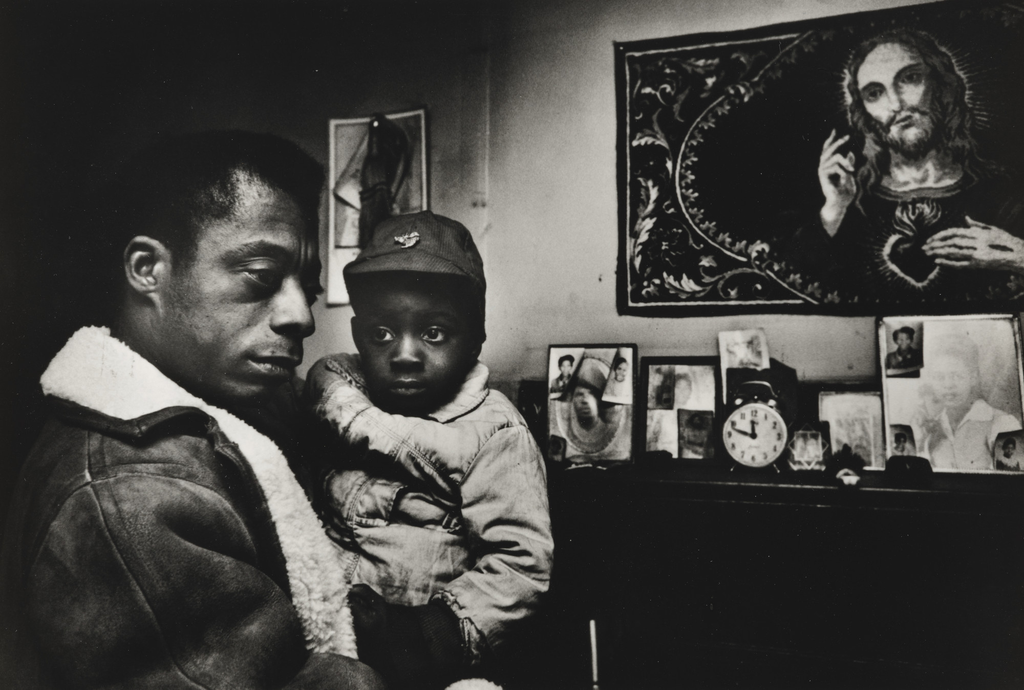
You can find my recently published interview with James Baldwin’s biographer in the 2026 September issue of the James Baldwin Review, “Escaping Myth with David Leeming: An Interview.”

This interview with David Leeming queries the scholar’s study of mythology as it intersects with his writing of James Baldwin’s biography. It took place on September 13, 2025 at his home in Stonington, Connecticut. Leeming discusses the cultural myths central to Baldwin’s writing and speech, Baldwin’s cultivation of Old Testament mythology, Baldwin’s view to escaping those myths, and the cultural myths that have informed decades of American politics. Leeming shares his perspective on the ongoing interpretations and cultural relevance of Baldwin’s work in the Trump era and his hopes for continued writing on Baldwin’s legacy.

Categories
Research & Publications

Forthcoming Book: 2027

Bursting Worlds Asunder: Doorways in Modernist Fiction (LSU Press, spring 2027) is my forthcoming scholarly book.

This work recharacterizes literary modernism as a sensorial, spatial, and temporal relationship with doorways in fiction. I examine envelopment, hiddenness, transcendence, ecstasy, rhythm, and presence in the doorways of Faulkner’s Sanctuary, Wright’s Native Son, Woolf’s Between the Acts, Kafka’s Amerika, and Joyce’s Portrait of the Artist as a Young Man. The final chapters extend myths about depth and interiority to Dziga Vertov’s 1929 film Man with a Movie Camera and David Lynch’s Inland Empire. Written from an interdisciplinary perspective of architectural theory, material studies, and phenomenology, this book redefines modernism as our ability to rebuild space and materials through perception.

Categories
Research & Publications

Vorticism and Iron

More on architecture and extensions of my new book, Bursting Worlds Asunder: Doorways in Modernist Fiction…

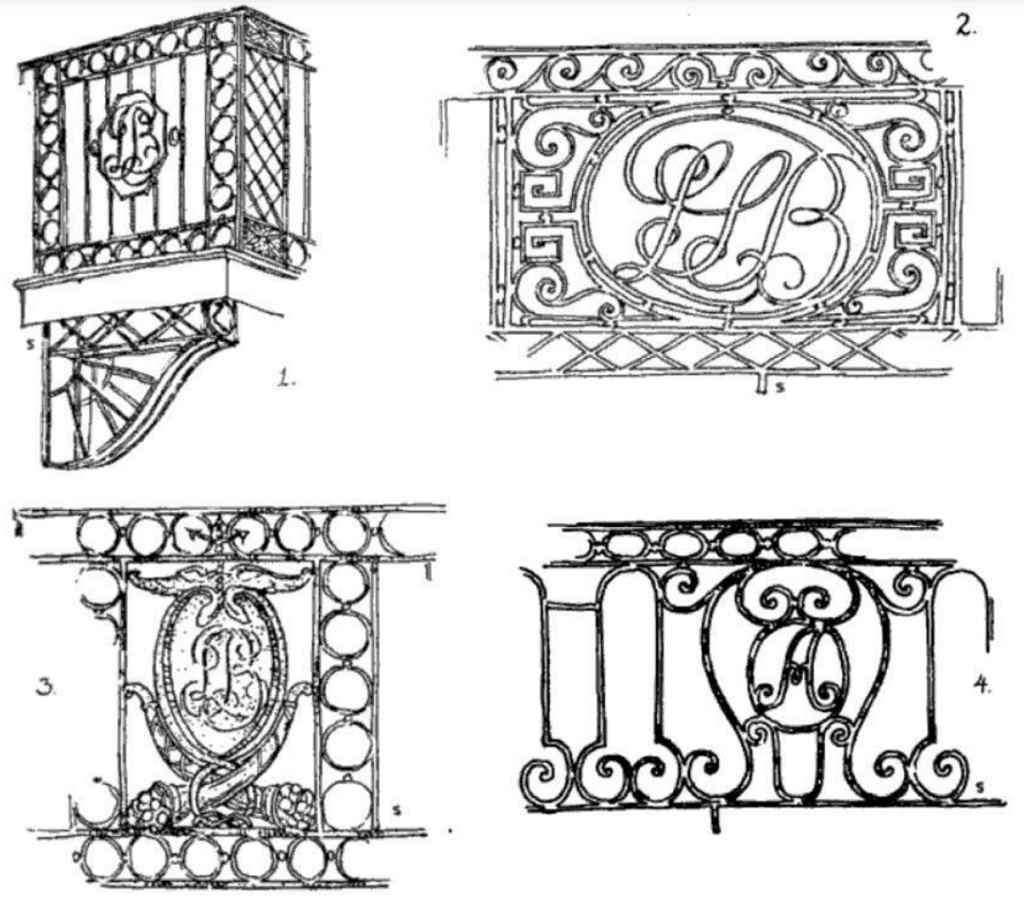
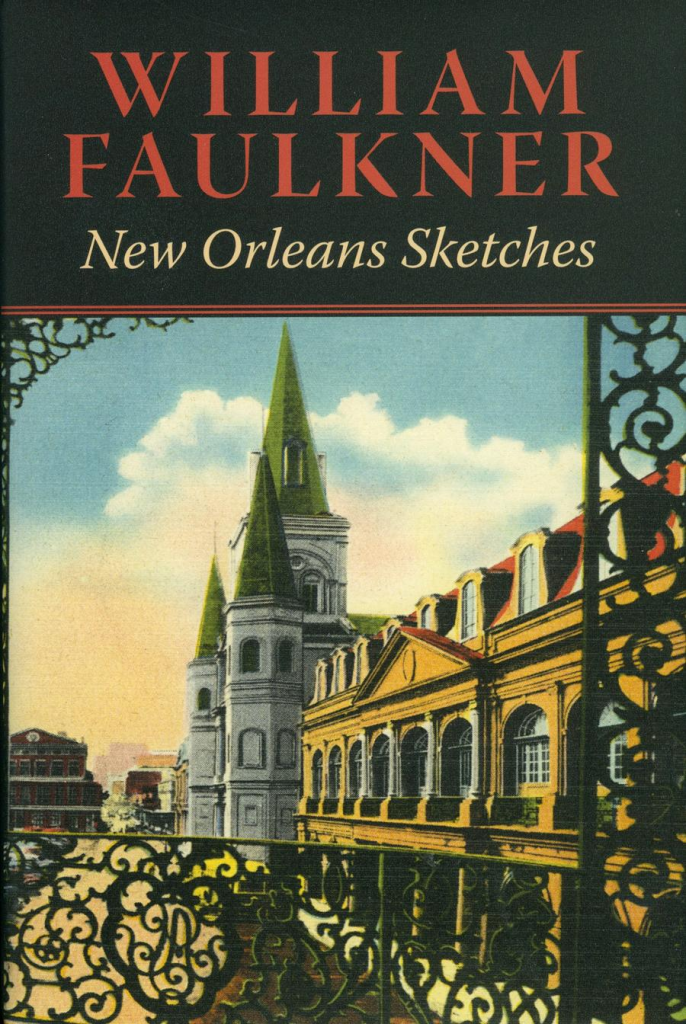
In “The Mirrors of Chartres Street,” his short fiction published in his New Orleans Sketches (1925) while living in the French Quarter of New Orleans, Faulkner describes the balcony as “Mendelssohn impervious in iron.”

In my article, “Vorticism and Iron: Faulkner’s Architectural Dialogue in ‘Mirrors of Chartres Street’” for the Mississippi Quarterly, I show the relationship between the movement of architectural lines and bodies in the text. Above are the drawings of New Orleans balconies by Faulkner’s roommate, William Spratling, an professor of architecture at Tulane University and an artist.

https://muse.jhu.edu/pub/1/article/921511

William Faulkner shows the objective and subjective world in intimate dialogue throughout his fiction. His pattern of representing bodies in conversation with buildings through movement and perception is integral to his vision of embodied experience. This article demonstrates how Faulkner employs competing romantic and modernist architectures in service of a descriptive ontology and a new theory of architecture. In “Mirrors of Chartres Street,” Faulkner offers a new mode of building that rejects the use of property or tools, heroizing the body itself as a means of building and dwelling.

Categories
Research & Publications

The Paradox of Door-Keeping

In relation to my forthcoming book, Bursting Worlds Asunder: Doorways in Modernist Fiction, see my article in MIT’s architecture journal Thresholds. “The Paradox of Door-Keeping: Access and Absurdity, Then and Now” was included in No. 50 Before/After: https://direct.mit.edu/thld/article-abstract/doi/10.1162/thld_a_00766/110236/The-Paradox-of-Door-Keeping-Access-and-Absurdity?redirectedFrom=PDF

Categories
Research & Publications

Special Issue: William Faulkner and the Work of Antiracism

Check out this important new issue published in the spring of 2023 of The Faulkner Journal, William Faulkner and the Work of Antiracism. Included is my article, “Baldwin, Individualism, and the Means of White Self-Empowerment.”

James Baldwin states in Nobody Knows my Name that what he observed white Americans did not seem to know about Europeans was also what they did not know about African Americans. Critics still look to Baldwin’s presentation of Faulkner’s personal, literary, and intellectual contradictions as the prototypical identity of white Americans in Baldwin’s famous essay “Faulkner and Desegregation.” Baldwin vividly realizes the still unrealized trauma inflicted upon the white American psyche by the institution of slavery in other works, offering Faulkner as an exemplary model. I suggest in this essay that an even more productive concept of the conditions of racism exists between Faulkner’s works and Baldwin’s other writings on national identity. I query how the distinct values of individualism, collectivism, and transnationalism affect racial empowerment in critiques between Baldwin and Faulkner. Furthermore, I demonstrate how Baldwin’s newly acquired European perspective has essential bearing on his critique of Faulkner’s brand of racism, allowing him to identify individualism and isolationism as inherently antithetical to the goals of personal freedom for all Americans.

Many thanks to Aliyyah I. Abdur-Rahman for being our guest editor, and to Ahmed Honeini and Peter Lurie. This issue features Dr. Abdur-Rahmen’s essay as well as an essay by Thadious M. Davis entitled, “Spaces of Remembering and Forgetting: On Antiracism.”

Categories
Announcements Research & Publications

Woolf’s Toggling as Visual Philosophy: Now in Print

Read my new essay, “Woolf in the Background: Distance as Visual Philosophy, Then and Now,” a chapter in the now-released collection on Mobility, Spatiality, and Resistance in Literary and Political Discourse. In this essay, I establish Woolf’s perceptive technique of “toggling” between foregrounds and backgrounds in Orlando. This way of writing reinforces and illustrates Woolf’s greater ontology of depth and betweenness:

https://www.palgrave.com/gp/book/9783030834760#aboutAuthors

Categories
Research & Publications

Faulkner and Slavery in Print

My essay “Ritual Architectures: Doorless and Makeshift Boundaries in Faulkner’s Slave Quarters” is now available in the Faulkner and Slavery collection in the Faulkner and Yoknapatawpha Series. The University Press of Mississippi released this work in June 2021:

https://www.upress.state.ms.us/Books/F/Faulkner-and-Slavery

Categories
Announcements

Hurston Fall Webinar Series

Join the Hurston Fall Webinar Series hosted by The University of Kansas. The starting webinar on October 1st hosts acclaimed biographer Valerie Boyd in her discussion of “The Afterlife of a Biography.” Free Registration and Open Admission.

Noon-1:30 p.m. Oct. 1 

https://today.ku.edu/2021/09/22/project-history-black-writing-series-will-further-explore-zora-neale-hurstons-life-legacy

Categories
Award Grants

NEH Summer Institute 2021: Hurston on the Horizon

Many thanks to the hosting faculty for selecting me as a participant for the 2021 NEH Virtual Summer Institute, Hurston on the Horizon: Past, Present, and Future.

Check out the faculty and work of the Project of the History of Black Writing: https://hurston.ku.edu/